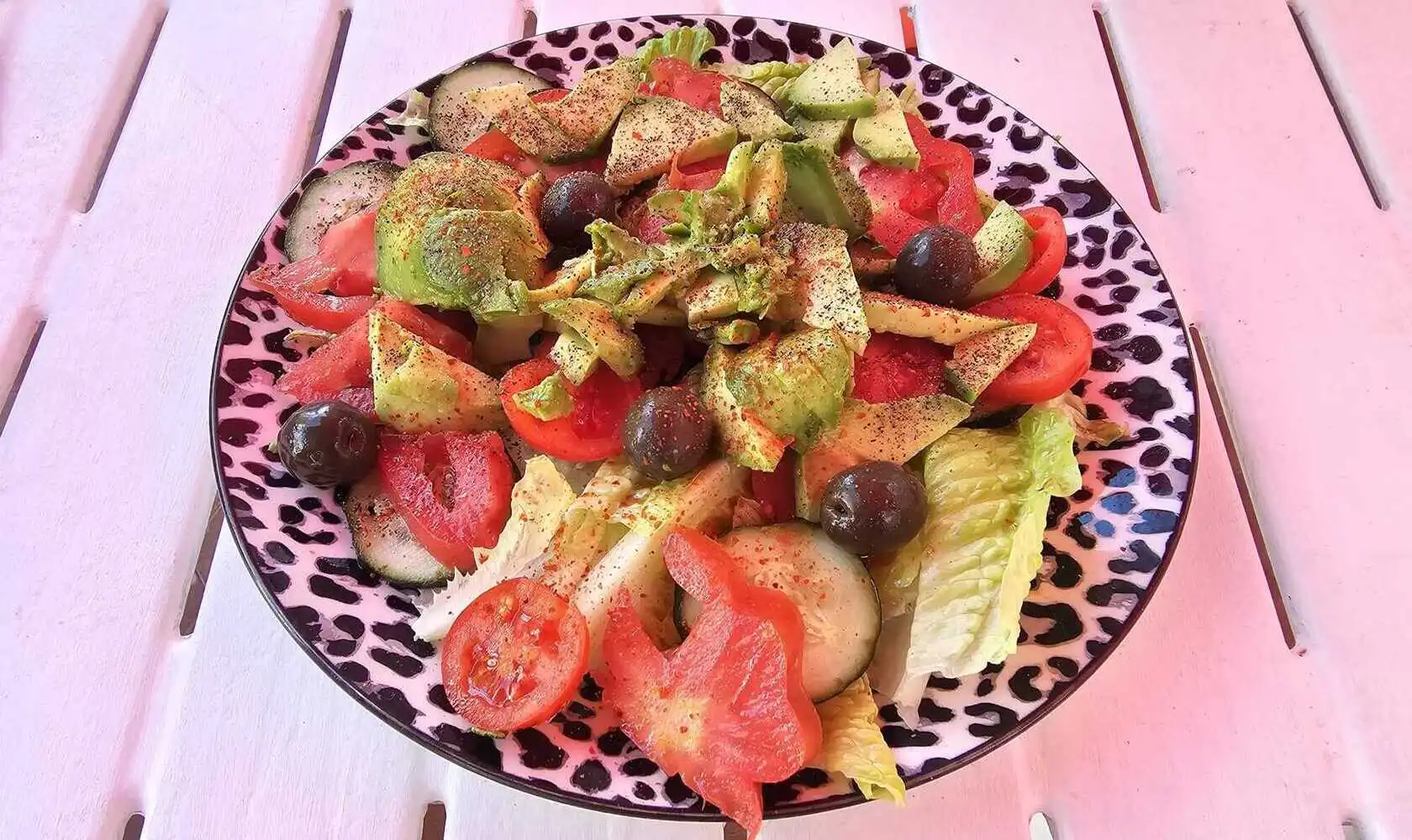
But vegans eat avocados, which need so much water to grow and are so bad for the environment and the climate. Apart from stepping on ants or being stranded on an island with only a pig, this is one of the most frequently repeated arguments in debates between non-vegans and vegans. While I personally cannot stand the taste or texture of avocados, I want to take a closer look at the scientific evidence behind this topic.
Are avocados bad for the environment?
Avocados are often criticised for their environmental impact, and there is some truth behind that. One of the main concerns is water use. According to data published by the UNESCO Institute for Water Education, producing one kilogram of avocados requires roughly 2,000 litres of water.
What matters most here is that a large share of this water does not simply come from rainfall, but from water taken from rivers, lakes or groundwater to grow the crop. That becomes a serious problem in places where water is already scarce.
This is one reason why avocado farming has come under criticism in regions such as Petorca in Chile, where large scale production has repeatedly been linked to water shortages. Another issue is land use. Mexico, the world’s largest avocado producer, has expanded avocado farming significantly in recent years.
In parts of Michoacán, this expansion has been directly linked to deforestation and biodiversity loss, with studies showing that around 20% of forest loss in the region between 2001 and 2017 is associated with the growth of avocado plantations.
Transport also plays a role. Most avocados sold in Europe or the US are imported from countries like Mexico, Peru or Chile and travel long distances before reaching consumers. They are usually shipped rather than flown, but these routes still leave a footprint through fuel use, emissions and energy needed for storage, cooling and ripening.
Who eats more avocados: vegans or non-vegans?
Let’s start from the premise that avocados are not the most environmentally friendly fruit that many people around the world enjoy. But is it justified to use this as an argument against a vegan diet? Who actually eats more avocados globally, vegans or non-vegans? According to the Food and Agriculture Organization of the United Nations, global avocado production now exceeds 10 million tonnes per year.
At the same time, there are estimated to be just under 90 million vegans worldwide. If vegans alone consumed all those avocados, each individual vegan would have to eat an average of 110 kg, or about 555 avocados, every year. Since I, for one, am not among the avocado-eating vegans, who is eating my share?
As shown in the World Avocado Map 2023, per capita avocado consumption is highest in Mexico at about 9 kg per person per year, followed by Chile at almost 8 kg. Australia and the United States also rank among the highest consuming countries, each with more than 4 kg per person per year.
Other sources, however, often identify the Dominican Republic as the most extreme case of all, with a staggering 48.9 kg per person per year. One reason it does not stand out as much in the World Avocado Map may be that many avocados there are grown and eaten locally rather than passing through the regular market.
Apart from the USA, none of these countries are strongly associated with veganism. In fact, countries in Central and South America in particular tend to have diets that are high in meat. If global avocado consumption were truly driven by vegans, one would expect the highest per capita consumption in countries like Israel, the United Kingdom or Germany.
Water use in food production
Water is needed for everything that grows. Every fruit, every vegetable and every crop needs it. That is why the topic is more complex than it often sounds in debates. It always depends on where and how a food is produced. Some crops mainly grow with rainwater, while others need extra water taken from rivers, lakes or groundwater.
This is why it is often cherry picking when people single out one specific fruit or vegetable as if it were the main problem. Looking at the bigger picture, animal products clearly use far more water overall. That is not just because animals drink water themselves. They also need to be fed, and growing their feed requires water too.
In other words, animal products add another full layer of water use on top of the crops already being grown. Large amounts of crops are produced for animals, and this goes far beyond what humans could ever eat directly in plant foods.
According to water footprint data published by the UNESCO Institute for Water Education, beef requires around 15,000 litres of water per kilogram. Pork comes to about 6,000 litres, chicken to about 4,300 litres, cheese to roughly 5,000 litres and eggs to around 3,300 litres per kilogram. Avocados, by comparison, require roughly 2,000 litres per kilogram.
So while avocados are not a low water crop, they are still well below meat, dairy and eggs in this regard. Anyone who is genuinely concerned about wasting water in food production should probably not focus on avocados first
Whataboutism in nutrition and lifestyle
The argument that vegans eat avocados and therefore do not live a perfectly ethical lifestyle is a typical example of whataboutism in the field of nutrition and lifestyle. When people cannot defend their position with a clear counterargument to the issue at hand, they often move to other topics they believe are closely or at least loosely connected.
Often, the topic they switch to is so abstract or not even truly logical, yet it still works because their debate partner becomes confused and thrown off, losing sight of the main point. The whole discussion then drifts into a topic where both sides are likely to have only partial knowledge.
As a consequence, both parties leave the discussion exactly where they started, each feeling that they somehow won the debate, while anyone watching remains just as clueless and indecisive as before.
I encourage anyone who wants to debate against veganism to be brave and stick with one point until the very end, where you either change your mind or agree to disagree.